The Year of Churn

As 2025 comes to a much needed close, I keep circling back to one theme. This was the “Year of Churn.” Nothing about this year felt steady which is why churn feels like the only word that fits.
Kicking Off the Year, Not with a Bang but with a Collective Shout
From January on, the shift was unmistakable. We went from a country that felt rooted in acceptance to one that split as deep as the Mariana’s Trench seemingly overnight. People showed up, spoke out, and stepped into unity as the year’s early injustices became impossible to ignore. The People’s March events filled more than three hundred cities on January 18, many carrying the call that “Women’s Rights are Human Rights.” It was a preview of everything that followed.
International Women’s Day on March 8 brought another wave of three hundred demonstrations across the country. Then came the “No Kings” protests on June 14 and again on October 18, totaling more than 4,800 demonstrations. The message was carried from city to city. It was consistent, loud, and clear. Public trust was slipping, and people were no longer quiet about it.
If you weren’t living under a rock this year, you saw women’s healthcare rights shift in real time down an unprecedented and dangerous path. States rewrote laws around abortion, family planning, and gender categories faster than most people could track. One of the most visible signs of this change was the sweeping removal of any references to diversity, inclusion, or women from government websites in what I call the “mass purge.”
Even an innocuous article about me from Osan Air Base’s Public Affairs Office during my time as Senior Enlisted Leader for a small unit on a Korean Air Force Base was caught up in the purge. I had simply said, “we had a diverse group of airmen that made the mission happen.” That harmless acknowledgment of twenty-six people from eighteen different career fields without references to ethnicities or genders suddenly became off limits.
The push to minimize women was widespread and felt at every level. To counter the erasure of women and the removal of critical health information, organizations stepped forward. TheSkimm reinstated the ReproductiveRights.gov website after it had been taken down. The Military Women’s Memorial started sharing the history of military women and encouraged female veterans to submit their own stories so our contributions to history would not disappear. However, many other pages were not as fortunate. The Arlington National Cemetery page could not restore content about women or service members of color. The CDC removed information on STDs, vaccine guidelines, LGBTQ+ health, and Alzheimer’s warning signs. Nearly two thirds of Alzheimer’s patients are women which underscores how dangerous that loss of information really is.
Jobs – Here Today, Gone Tomorrow
If you’ve been following the job market this year, you’ve seen another pattern that is creating a lot of churn: companies hype the next big innovation one month, then lay off thousands of employees soon after.
Intel kicked off the year at CES in January with their new Intel Core Ultra processors for computers and Adaptive Control Units for EVs, promising major performance gains in both AI and automotive markets. Just three months later, they announced plans to cut 20% of their workforce—about 24,000 jobs. The reasons: they canceled the automotive chip project and eliminated layers of middle management as part of a broader restructuring.
Amazon is downsizing as well. Remember when AWS was the next big thing and everyone scrambled to get on board? While Amazon still sells everything from A to Z, CEO Andy Jassy now sees AI as a path to streamline the corporate workforce. With AWS positioned as the future of cloud and AI driven work, the company began reducing its corporate footprint. Cuts hit the AWS cloud division, the services and devices teams, HR, and other parts of the organization. About 14,000 roles have already been eliminated, and projections suggest up to 30,000 jobs could eventually be affected.
The real kicker of this chaos? Some of these job cuts ties directly to a policy that was supposed to increase American jobs. Tariffs have slapped many industries with higher costs and the consequences came fast. The Center for American Progress reported that more than 42,000 manufacturing jobs have been lost since April because of tariff driven cost increases. A survey by PlantTours, shared in CFO Brew, found that 45 percent of layoffs in construction and manufacturing were linked directly to tariffs.
The Future of Professionals
BUT if that is not enough churn, here is a little more. The US Department of Education has now listed several degrees they no longer consider “professional.” While tuition has more than doubled in the past 30 years, students in the following fields may no longer receive reimbursement for their studies.
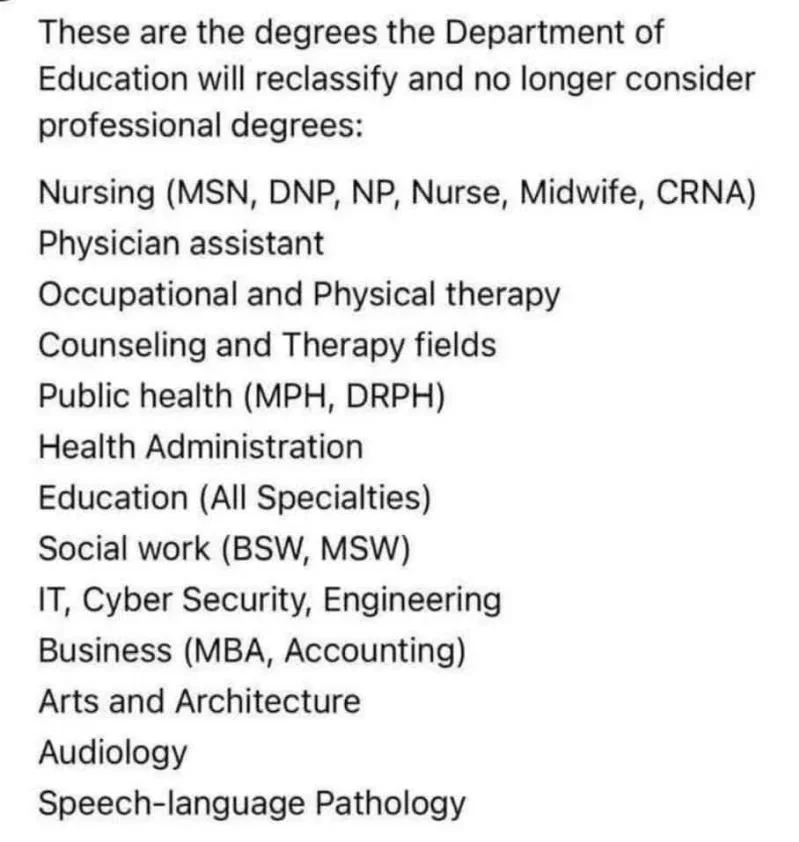
Let’s take a moment to step back and think this through. Nurses, physician assistants, physical therapists, therapists, and speech pathologists all spend several years in school and play a direct role in keeping our health care system functioning. The list also includes educators, accountants, and architects. These careers require formal training, certifications, and licenses, and they remain in high demand. It is hard to imagine that any of them could suddenly be viewed as something other than professional fields.
Many of these fields are already experiencing serious staffing shortages. Reclassifying them as nonprofessional will only make the problem worse, especially when the required education comes with a significant financial burden. So, what happens if there are not enough nurses or physical therapists to care for patients? What happens when we do not have enough teachers for school systems that are already stretched?
Another point worth noting is that most of the jobs on this list have a significantly higher number of women than men. Nursing has a 9 to 1 female to male ratio, while counseling sits at 4 to 1. Women make up 87 percent of teachers and 81 percent of social workers in the United States. About 70 percent of physical therapists and 92 percent of occupational therapists are women. When you look at the numbers together, it becomes hard to ignore the pattern. Reclassifying these roles feels like yet another attempt to minimize women.
The Push for Women’s Health
But not everything this year has been negative. After the mass purge, a renewed focus on women’s health emerged. From January to September, BioWorld reported that thirty-seven women’s health–focused venture funds raised billions of dollars. That momentum is impossible to ignore.
Foreground Capital set the tone early. Partner Alice Zheng announced RH Capital Funds I and II in January with an investment thesis centered entirely on women’s health. It acknowledged decades of underinvestment and signaled the start of real change.
In August, the Gates Foundation announced a 2.5 billion dollar commitment to women’s health innovation and research. Their focus areas included obstetric care and maternal immunization, maternal nutrition, menstrual and gynecological health, contraceptive innovation, and sexually transmitted infections. This was roughly one third more than what the foundation had invested in the previous five years.
FemHealth Ventures and SteelSky Ventures continued to move fast. Both have supported women’s health companies for years but this year their portfolios hit new milestones through FDA clearances, funding rounds, and acquisitions.
Melinda French Gates has been driving opportunities and innovations for women as well. Through her firm Pivotal Ventures, she has committed hundreds of millions of dollars to transform women’s health and rights. In 2025, she launched a $100 million initiative in partnership with Wellcome Leap to fast track research into conditions that disproportionately affect women, from cardiovascular and autoimmune disorders to mental health issues. She also awarded $250 million in grants to more than eighty nonprofits worldwide, many of them community-based organizations receiving this level of funding for the first time. Her work, from grant making to research investment to advocacy, demonstrates a renewed momentum for women’s health and equity and makes 2026 feel full of possibility.
Women Raising Up in Unity
Amid all the chaos and the ongoing minimization of women, something powerful has emerged. Women across the US are rising together.
Reshma Saujani has been a tireless advocate for women. As the founder of Girls Who Code and Moms First, her voice continues to cut through the noise. This year, she appeared on countless podcasts and stages, talking about what it really means to support moms and calling attention to the pay gap for women over fifty. She’s also working on a film about the history of motherhood in the United States, set to release next year, which gives me hope for what 2026 might bring.
Fatou Baldeh has spoken out against female genital mutilation and gender-based violence. Claire Babineaux-Fontenot has addressed food insecurity and the struggles of mothers. Amanda Gorman was named a UNICEF ambassador for her work tackling systemic issues affecting girls, including education and human rights.
Looking Ahead to 2026
As heavy as this year has felt, I keep coming back to the same truth. Churn may have defined 2025, but it did not break us. It revealed who we are when the ground shifts beneath our feet. It showed that even in the middle of chaos, people still reach for one another. Women still fight for their place. Communities still mobilize. Leaders still rise.
The year was turbulent, confusing at times, and deeply frustrating. Yet alongside all the loss, there was clarity. The collective pushback against erasure. The movement toward more health research focused on women. The voices that refused to dim, no matter how loud the noise around them became. That is the part of 2025 worth carrying forward.
We saw what happens when people show up. We saw how quickly women rally when the stakes are high. And we saw a new generation of leaders begin to reshape the conversation, not from the sidelines but from the center. That shift matters more than any single policy or headline.
As we step into 2026, I am choosing to hold onto that momentum. I am choosing to believe that unity can outweigh churn. I am choosing to believe that the women who spoke up this year will not only continue the work but inspire even more to join them.
If 2025 forced us to face the cracks, then 2026 gives us a chance to rebuild with intention. Not quietly and not cautiously, but with the full weight of everything we learned this year. My hope is that the year ahead becomes one where women are not minimized but centered, supported, and celebrated. One where progress is no longer the exception but the expectation.
Because if this year taught us anything, it is that women are not stepping back. Not now. Not ever.
https://www.theguardian.com/us-news/2025/jun/14/no-kings-protests-trump-military-parade
https://www.the50501movement.org/p/no-kings-day-7-million-october-18-historic-protest-2025
https://www.mobihealthnews.com/news/qa-womens-health-funding-2025
https://www.newsweek.com/full-list-degrees-professional-trump-administration-11085695
https://www.careerexplorer.com/careers/physical-therapist/demographics/